
i've got beef with finding nemo
seeking justice for the anglerfish

The first time I encountered the deep sea was in Marquee Cinemas—Coralwood 10 in Cape Coral, Florida, located smack dab in the middle of a strip center and flanked on either side by a Hallmark Store and a Sears, both of which have now permanently closed down. May they rest in peace.

Marquee Cinema—Coralwood circa 2004.
I grew up on a small barrier island on the Gulf Coast of Florida, and the Marquee, forty minutes away, was the closest movie theater to us. It was always special when my family—my mother, father, brother, and me—made the trek to the failing Marquee theater to see a movie.
It was early summer, towards evening, in 2003. We got our tickets (how I miss the box office days of physical ticket purchases and unassigned seating!) for the new Pixar film, Finding Nemo, heralded for its stunning visuals of undersea life.
I don’t remember much at all about that day besides the dark damp of the theater, the moldy-sweet smell of the seats mixed with the buttery grease of popcorn, and my childhood nightmare: the anglerfish.
Oh, yes. The anglerfish.
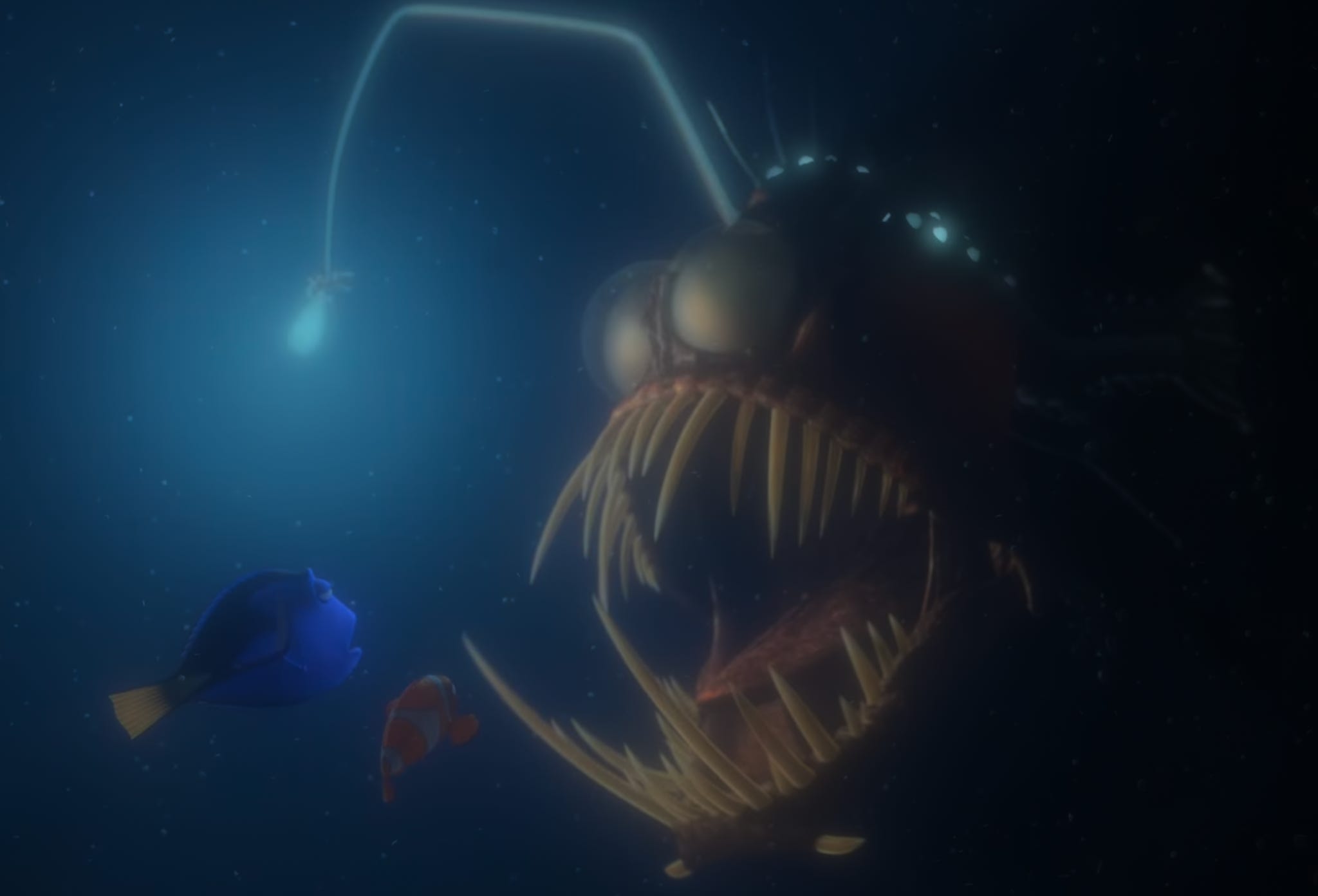
After watching Finding Nemo, my dreams were haunted by the deep sea. I had a recurring nightmare that, while swimming in the ocean, a massive anglerfish swam up from the depths, bared its needle-like fangs, and swallowed me whole.
I refused to enter the ocean for months because I was convinced that a glassy-eyed monster with a bright lure might eat me as though I were as small as a clownfish.
But then, one night, my dad, a doctor and botanist, told me something that changed my fear entirely.
“You know anglerfish are really small, right?”
“What do you mean?” The image I had in my mind of an anglerfish was a copy-paste from Finding Nemo.
“A lot of deep-sea animals are small. They have to be because there’s not a lot of food down there.”
On our family computer, he clicked the “e” logo for Internet, since Google did not yet hold a monopoly on everything, and showed me a picture online.
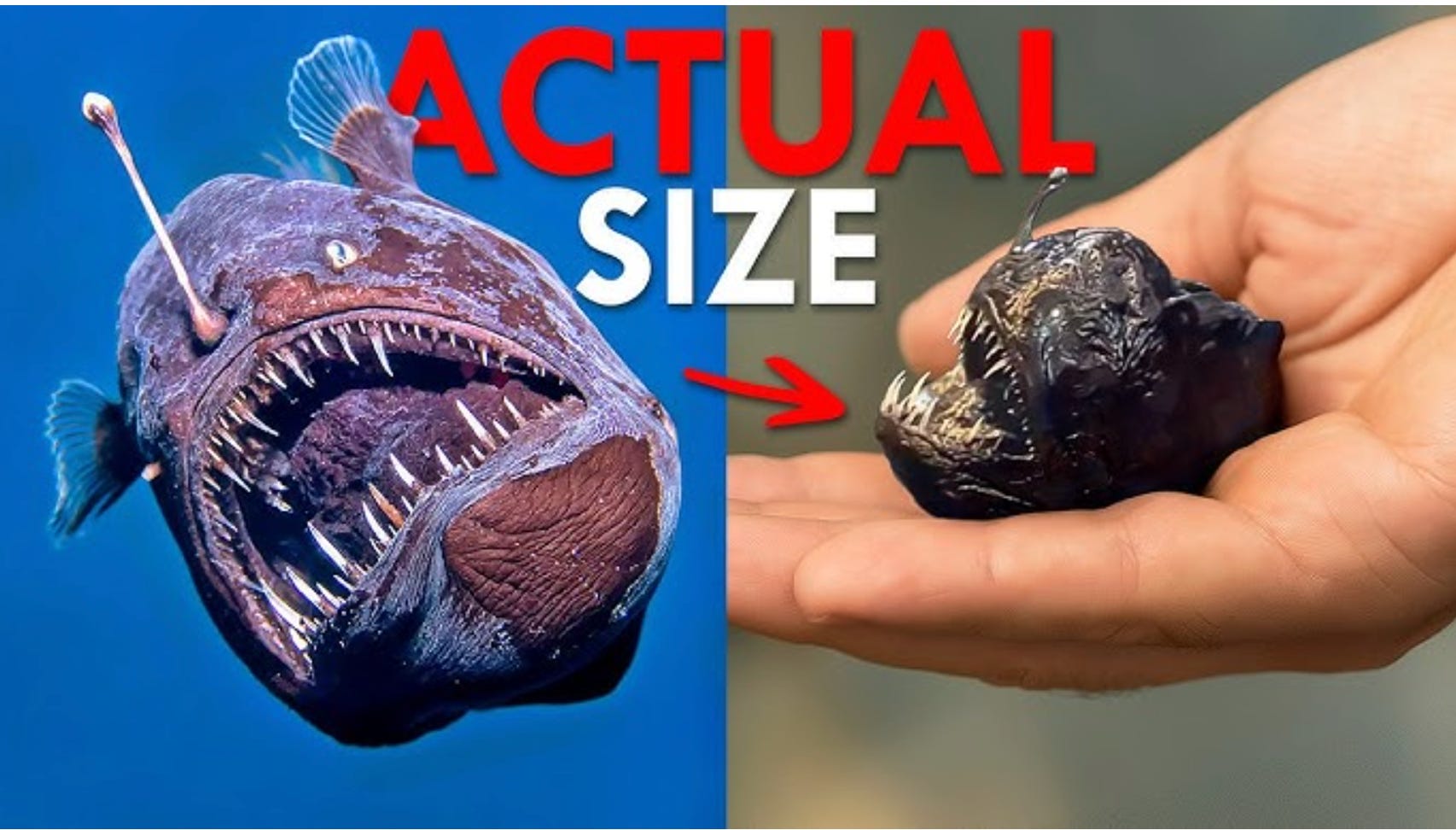
He was right. Anglerfish are remarkably small. The females are five to six inches at most, and the males are one inch.
I’d been terrified of a creature no larger than my hand.
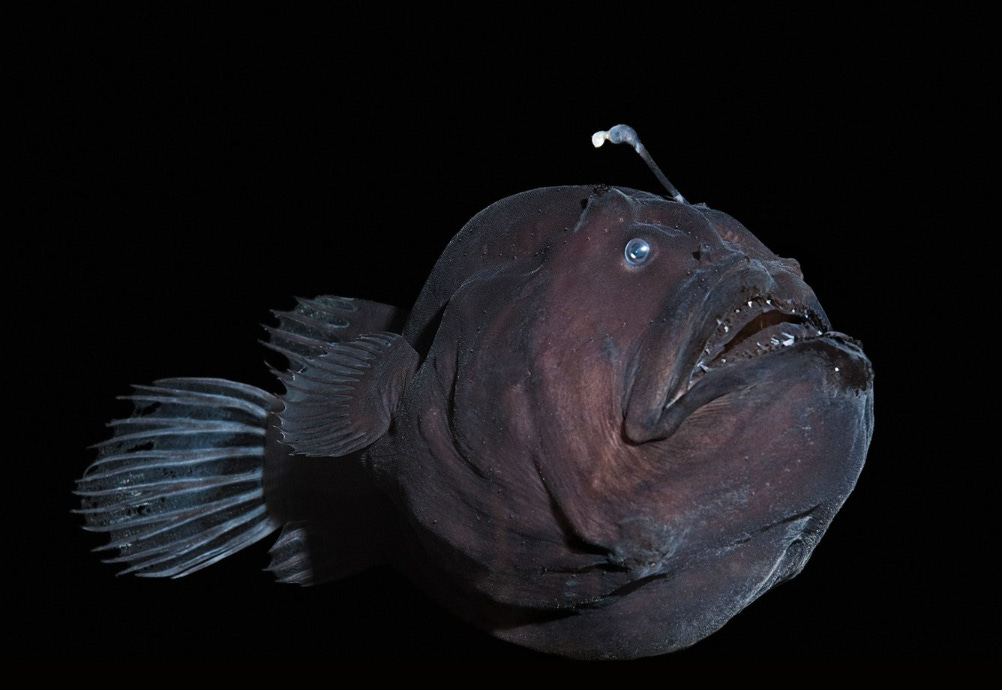
Black seadevil anglerfish (photo by Doug Perrine). Females measure approximately 6-8
inches, while males measure under one inch.
vindicating the anglerfish
First, let me acknowledge that Finding Nemo has done some good. It taught me about coral reefs, and cyanobacteria, and turtle migrations, and the importance of not capturing a wild fish and putting it in a tank in a dentist office. (Ironically, the release of the film led to the “finding Nemo” effect, in which demand for pet clownfish skyrocketed after the film, causing more harm than good, at least for clownfish [Militz and Foale 3]).
Yet while the film extends emotional complexity and ecological attention to reef ecosystems, this attentiveness wanes once Marlin and Dory descend into the abyss in search of a diving mask containing the address where Nemo was taken.
Here are my main gripes with how Finding Nemo represents the deep sea.
charge 1: the deep sea is not the real deep sea, but an emotional landscape
They descend not into the deep sea, but into an emotional landscape created from preconstructed notions of deep-sea environments.
Compared to the visual cornucopia of the reef, where sea cucumbers, plankton, and coral appear in stunning visuality, the deep sea is portrayed as a nightmare zone, building on children’s fear of the dark and deep water, rather than a vital part of the ocean that serves as important a role on our planet as the reefs.
Such treatment of the abyss contributes to what Jamieson et al. call the “enigmatisation” of the deep sea, in which it is presented in terms of the feelings it evokes in humans—thalassophobia, fear, gloom, and depression—rather than on scientific information about the abyss (803).
charge 2: the anglerfish is not a real anglerfish
The anglerfish that appears is a Frankenstein-assemblage of many different deep-sea creatures.
Arasu and Jamieson note that, “Finding Nemo is one of several films which draw upon the anglerfish to evoke deep-sea alterity and therefore the danger presented to the protagonists” (20). In order to create a spectacle, the creators forsake scientific accuracy and instead make an anglerfish-inspired monster of “parts taken from multiple different animals” (“The Lure of the Anglerfish”). The anglerfish that appears in the movie, for example, has the exaggerated teeth, jaws, and ilicium of a viperfish, with the large and opaque eyes whose size is more accurate to a barreleye fish.
I get it—it’s a kid’s movie and not a documentary. But, Finding Nemo bills itself as a piece of media that educates about anemones, the east Australian current, and sea cucumbers. Why doesn’t it apply its educational mission to one of the most misunderstood environments on the planet?
Furthermore, the anglerfish chase scene only reinforces the function of the anglerfish as a spectacle rather than a living animal.
The anglerfish chase scene immediately follows Marlin and Dory’s escape from Bruce, a great-white shark struggling to maintain his abstinence from eating fish. During Bruce’s attack, the film grants the sharks a surprising degree of psychological nuance: as Bruce wrestles with his instincts, the other sharks reassure Marlin and Dory that “he doesn’t mean it,” and the sequence frames predation as an internal struggle between desire and self-control.
The anglerfish attack that follows offers a stark contrast. Rather than a socially intelligible predator grappling with internal contradictions, the anglerfish appears to operate entirely through brute instinct. Prema Arasu has argued that “The monsterisation of deep-sea animals represents the need to project a fear of the deep, dark other onto the transgressive body of an entity which can be defeated, as we see in the escape from the anglerfish” (53). The anglerfish snaps and lunges more like a bucking bronco than the ambush predation preferred by the real life anglerfish.
In effect, the anglerfish appears less emotionally nuanced and less narratively developed than other predators in the film, establishing it as “lesser” to other marine inhabitants.
charge 3: the anglerfish is one of the only non-speaking fish in the film
Most significantly, the anglerfish is the only fish in the whole movie that doesn’t talk. It has weird-looking, soulless eyes, and it literally screams. No, actually. The sound director used something called a “Hydra scream” constructed by the slowed-down sound of a pig squeal.
Unlike the sharks, who speak, joke, and negotiate social bonds, or the whale, whose sounds Dory attempts to interpret, understand, and mimic later in the movie by learning to “speak whale,” the anglerfish communicates only through roaring.
What is at stake here is not only that the anglerfish does not speak, but that the film denies it recognizable subjectivity altogether. Unlike the sharks or whale, whose behaviors are translated into intelligible sociality, the anglerfish remains a monstrous spectacle.
While the movie does a laudable job bringing attention to the vibrancy and importance of coral reefs, that kind of compassion and empathy stops in the deep sea. Deep-sea critters are made speechless, alien, and estranged.
why this matters
Cultural perception of the deep sea is mainly shaped by its representation in media. Think about it: most of us will never go to the deep sea. We encounter it through documentary footage, photos, and animated movies and books that help us imagine what it is like to be there.
So, while it may seem harmless or funny the way that the anglerfish appears in Finding Nemo, it actually shapes the way we see and value the deep sea, and it can do real harm to the way we think about ecologies we can’t readily access but that are nevertheless vital to our ecosystem and vulnerable to destruction.
In an age of deep-sea mining where the abyss faces its most dangerous threat ever, telling stories about the deep sea that make it a nightmare zone undeserving of care and compassion only reinforces its marginalization. We need stories that emphasize the beautiful vibrancy, strangeness, and invention of the deep sea so that we can advocate for its protection.
The anglerfish is a fragile benthic being. It looks different from us (humans). It lives in very different conditions; just as the anglerfish appears shocking in our world, we would also appear very shocking (and quite poorly adapted) at the bottom of the sea.
It’s a common trope to make deep-sea animals monsters and aliens. I think it’s the easy way out. We often relate to animals through anthropomorphism, and since deep-sea animals strain our ability to find “human-ness” in them, we write them off as radically other.
But what if, instead of alienating and monster-izing the deep sea, we try to find connections through and across difference? What if we acknowledge our very distinct habitats and ways of being, and find connections across it?
Sabrina Imbler, quoting Timothy Morton, describes the “The philosopher Timothy Morton has a notion of other species as ‘strange strangers,’ arguing that intimacy should hold space for strangeness, where all beings can be their full selves, however incomprehensible those selves may be to others. Nature is beautiful and full of weirdos: slime-spitting velvet worms, fluttering sea angels, even possums. Although these creatures may be strange to us, we are strange to them, too. Dr. Morton proposes that this strangeness reminds us that we are all interconnected and that ‘every life-form is familiar, since we are related to it’ (“Are You Really So Different from the Blue Sea Blob?”).
Finding connections with strange strangers, with our kin at the bottom of the sea, can ask us to engage our imaginations, to consider alternate forms of embodiment, and to challenge the narrow and small conception of the world we as humans hold. In my humble opinion, these are all very good things.
Yes, anglerfish are weird-looking. But wouldn’t it be so wonderful to never need to own a flashlight again, or wear a headlamp? Isn’t there something divine, and even luminous, that we once, long ago, shared a common ancestor with the anglerfish, that we, too, once made light at the bottom of the sea?
works cited
Arasu, Prema and Alan Jamieson. “The Lure of the Deep Sea: Anglerfish as Movie Monsters.” Journal of Geek Studies, vol. 10, no. 1, 2023, pp. 19-28.
Finding Nemo. Directed by Andrew Stanton and Lee Unkrich, Pixar Animation Studios, 2003.
Imbler, Sabrina. “Are You Really So Different From the Blue Sea Blob.” New York
Times, 24 November 2022, https://www.nytimes.com/2022/11/24/opinion/sea-creatures-blue-blob.html
Jamieson, Alan et al. “Fear and Loathing of the Deep Ocean: Why Don’t People Care About the Deep Sea?” ICES Journal for Marine Science, vol. 78, no. 3, 2020, pp. 797-809.
Militz, Thane A. and Simon Foale. “The ‘Nemo Effect’: Perception and Reality of Finding Nemo’s Impact on Marine Aquarium Fisheries.” Fish and Fisheries, vol. 18, no. 3, 2017, pp. 1-11, https://www.researchgate.net/publication/312628889_The_Nemo_Effect_Perception_and_reality_of_Finding_Nemo_’s_impact_on_marine_aquarium_fisheries